How Much RAM Do Game Servers Actually Use? 28 Days of Fleet Data
Every RAM recommendation page on the internet — including ours — tells you what a game server should need. Few show what servers actually use. So we pulled 28 days of per-container memory data from every game server running on our nodes, measured hourly from September 17 to October 15, 2026, and report here on the four games with enough servers for the numbers to mean something.
The short answer
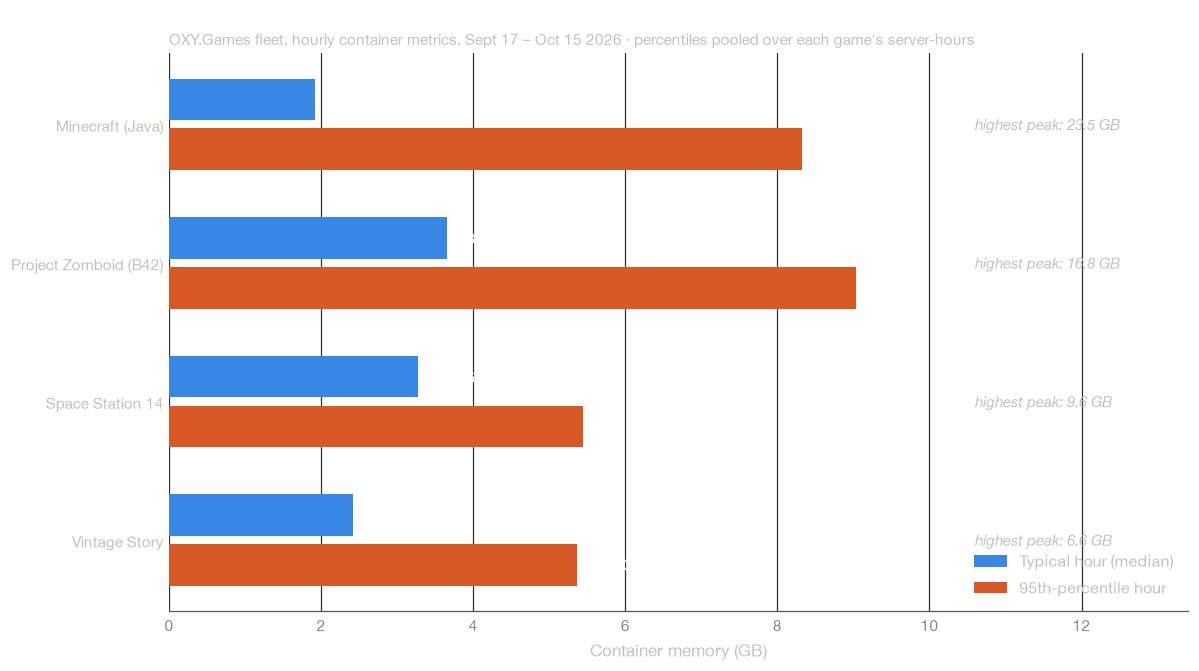
| Game | Typical hour (median) | 95th-percentile hour | Highest hourly peak |
|---|---|---|---|
| Minecraft (Java) | 1.9 GB | 8.3 GB | 23.5 GB |
| Project Zomboid (Build 42) | 3.7 GB | 9.0 GB | 16.8 GB |
| Space Station 14 | 3.3 GB | 5.5 GB | 9.6 GB |
| Vintage Story | 2.4 GB | 5.4 GB | 6.6 GB |
Both percentile columns are computed over hourly averages, pooled across each game's whole fleet — 1 in 20 measured server-hours exceeded the 95th-percentile number. The peak column is the highest single hourly maximum any server of that game recorded.
Three things jump out of the data:
- Typical and high-memory hours are different numbers. Each game's 95th-percentile hour ran at 1.7 to 4.3 times its median hour — partly bigger servers, partly busier hours — and the single heaviest hour we recorded ran at more than ten times the median (Minecraft's 23.5 GB vs. its 1.9 GB median). Your plan isn't priced for the median hour — it's headroom for the other kind.
- Most measured hours are modest. Medians of 1.9 to 3.7 GB across four games sit far below typical plan sizes. That's not an argument against the sizing guides — it's an argument for starting at a sensible tier and resizing when your own usage says so, instead of buying 16 GB "to be safe" on day one.
- The game you host shifts the baseline. In our data, a median Project Zomboid hour is nearly twice a median Minecraft hour. Per-player rules of thumb only make sense on top of a per-game base.
How we measured
- Source: hourly per-container memory metrics from our own monitoring, across every game server on OXY.Games nodes, September 17 – October 15, 2026 (a 28-day window).
- Percentiles are pooled over server-hours, not per server: servers that were online more weigh more, and short spikes inside an hour can hide in hourly averages.
- Only running servers produce data. A stopped container logs nothing, so these figures describe servers while they run — and a meaningful share of provisioned servers sat switched off for the entire window. Idle friend-servers are a real part of hosting too; they just don't generate memory data.
- Container memory is observed usage, not a measured minimum requirement. It can include OS file cache, and on the Java games a heap that is sized to the plan — more on that below.
- Fleet statistics only. We publish aggregates, not per-game server counts or individual customer data. The four games below are the ones with enough monitored hours to report reliably; the rest are covered in "What we left out".
Minecraft: the big fleet
Minecraft is by far the largest slice of our fleet, and the servers on it run everything our panel offers — Paper and Purpur with plugins, Forge, NeoForge and Fabric modpacks — switchable without reinstalling, so we can't split these stats cleanly by server software. Fleet-wide:
- Median hour: 1.9 GB. Half of all Minecraft server-hours used less than that.
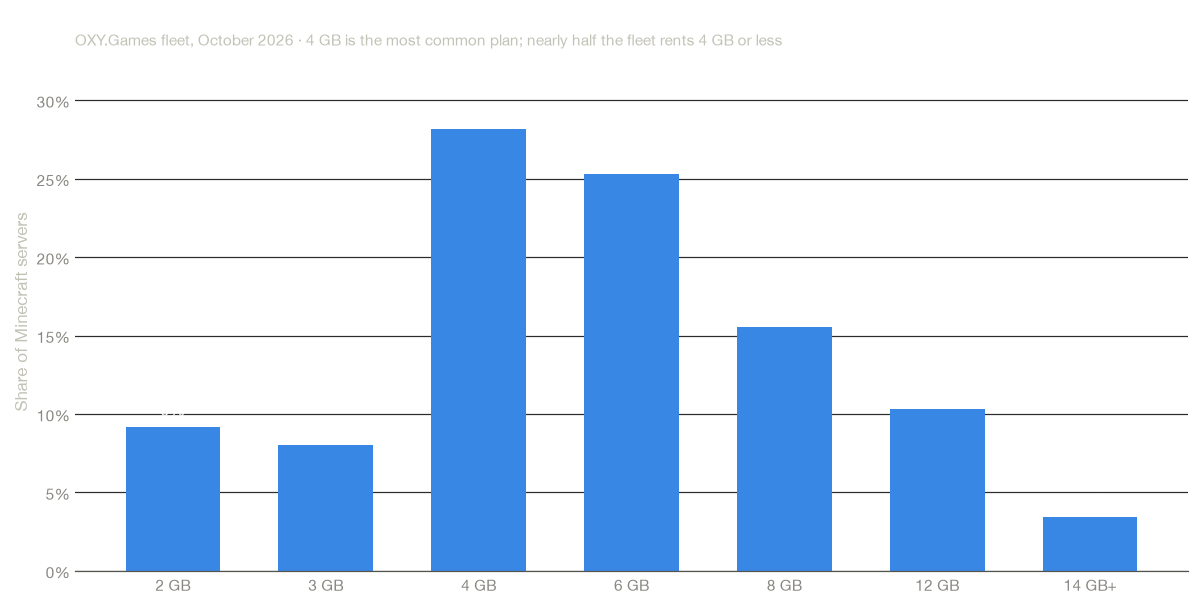
- Nearly half the fleet rents 4 GB or less — and for a small vanilla or lightly-plugged group, the usage data says that's a sane choice, not a compromise.
- The busiest 5% of server-hours ran above 8.3 GB. Here's the thing: a 4 GB container physically can't produce an 8 GB hour — its limit stops it. Those heavy hours come almost entirely from the minority of servers on 12 GB-plus plans: the big communities, the plugin networks, the heavy modpacks. A pooled 95th percentile describes the fleet's heavy tail, not your three-friends survival world. The highest hour we saw all month, 23.5 GB, came from one of the largest plans in the fleet.
One mechanism worth understanding for the two Java games in this article (Minecraft and Project Zomboid): our images derive the maximum Java heap from the plan — kept below the container limit to leave room for the JVM's own overhead — and the JVM doesn't always return committed memory to the operating system right away. Add file cache on top and a busy Java server's container usage can sit near its cap for long stretches — that's partly memory accounting, not pure demand. It's the main reason "my server uses all its RAM" is usually not a problem in itself.
Practical sizing — the same shape as our Minecraft plan table: 2–4 GB for a small vanilla group, 4–6 GB with plugins, 6–8 GB for light modpacks, 10–12 GB for heavy packs, 16 GB+ for ATM-class packs.
Project Zomboid: the hungriest of the four
- Median hour: 3.7 GB — nearly double Minecraft's median.
- The busiest 5% of server-hours ran above 9.0 GB.
- The highest hour we recorded was 16.8 GB, on the largest Project Zomboid plan in the fleet.
This is consistent with our Build 42 deep dive, which used a stricter cut — a month of actively played servers, reported per server — and found a ~4.9 GB typical figure with nearly every server touching its full allocation at least once. The broader pool here includes quieter worlds and weighs servers by online hours, which lands lower; different cuts, same picture. The community rule of thumb we use stands: about 6 GB base plus 0.5 GB per player, plus 2–4 GB for mods — full measurements and first-boot behaviour in the PZ guide.
Space Station 14: the fork sets the floor
- Median hour: 3.3 GB; busiest 5% of server-hours above 5.5 GB; the highest hour, 9.6 GB, came from one of the larger plans.
- The spread has a specific mechanism we've written about: content-heavy forks package client zips of around 2 GB, and under hybrid ACZ the server builds an in-memory copy of that client the first time a launcher asks for it — zip size and memory use aren't the same number, but from the first connection the fork's content size sets a memory floor that has nothing to do with player count. On top of that floor, usage grows with entities, atmos tiles and items in the round.
- That's why one SS14 server idles happily in a small container while another peaks near 10 GB on the same game.
Sizing: our SS14 hosting guide covers plan choice (small groups genuinely run fine on small plans; bigger forks and communities want 8 GB+), and the compile-from-source guide covers custom builds and the ACZ mechanism in detail.
Vintage Story: the calmest of the four
- Median hour: 2.4 GB; busiest 5% above 5.4 GB; the highest hour all month was 6.6 GB.
- One honest caveat: these servers were online for roughly 60% of the window's hours, the lowest coverage of the four games — so the numbers rest on fewer measured hours than the others. Coverage at that level partly reflects classic switch-it-off-between-sessions friend-servers, partly provisioning dates and monitoring gaps.
For sizing, the official guidance is 1 GB base + 300 MB per player (the developer calls it a rough, conservative estimate); our plan advice: 6 GB for most modded groups, 8 GB for heavy mod lists — see our Vintage Story plans.
What we left out, and why
Honesty about the cutting-room floor: several games on our nodes — ARK, Terraria, a few others — produced too few monitored hours to publish as statistics. One anecdote worth sharing anyway: no Terraria server we measured passed 1.7 GB all month, the smallest footprint in this dataset — but with that little data, take it as an anecdote, not a benchmark.
Start sensible, resize on evidence
If you take one number from this article, don't make it a median. The median hour is cheap everywhere — 1.9 to 3.7 GB depending on the game. The hours your plan exists for are the other ones: world generation on first boot, a big update, the whole group online at once, a mod loading a map expansion. Across this dataset the 95th-percentile hour ran at 1.7–4.3× the typical hour — partly bigger servers, partly busier hours — and the single worst hours further still.
The good news: you don't have to guess once and live with it. Start at the tier the per-game advice suggests, watch what your group actually does for a few weeks, and adjust — upgrading takes a few clicks in the client area plus a restart, your world stays exactly where it is, and downsizing works the same way as long as your world still fits the smaller plan's disk. That beats paying for 16 GB "to be safe" from day one; the data says most measured hours sit far below it.
FAQ
How much RAM does a Minecraft server need?
Across our fleet, the median server-hour uses 1.9 GB, and nearly half of all servers rent 4 GB or less. Plan for 2–4 GB for a small vanilla group, 4–6 GB with plugins, 6–8 GB for light modpacks, 10–12 GB for heavy packs — the heaviest fleet hours, past 8 GB, came almost entirely from the largest plans.
How much RAM does a Project Zomboid server need?
Build 42 is the hungriest of the four games we measured: the median server-hour is 3.7 GB and the busiest 5% of server-hours exceed 9 GB. The community rule of thumb we use: about 6 GB base plus 0.5 GB per player, with 2–4 GB extra for mods — our Build 42 measurement article has the full breakdown.
How much RAM does a Space Station 14 server need?
The fork sets the floor: content-heavy forks hold an in-memory copy of a roughly 2 GB client package under hybrid ACZ, and usage grows with entities in the round. Our fleet's median hour was 3.3 GB, with the highest hour at 9.6 GB. Small groups on lean builds run fine on small plans; big forks want 8 GB or more.
How much RAM does a Vintage Story server need?
In 28 days, no Vintage Story server on our nodes exceeded 6.6 GB — the median hour was 2.4 GB. Official guidance is 1 GB base + 300 MB per player; in practice 6 GB suits most modded groups and 8 GB covers heavy mod lists.
Should I size my server for average or peak usage?
For the high-memory hours, not the average. Across our fleet, each game's 95th-percentile hour ran at 1.7–4.3× its median — partly bigger servers, partly busier hours. Size for first boots, updates and full-group evenings — then adjust once a few weeks of real usage tell you what your group actually needs.
Sources & further reading
- Project Zomboid Build 42 Server: RAM & Requirements — the single-game deep dive behind the PZ numbers
- Space Station 14 server hosting guide and compiling SS14 from source
- Game server plans at OXY: Minecraft · Project Zomboid · Vintage Story
All figures measured on OXY.Games nodes via per-container monitoring: hourly trend data, September 17 – October 15, 2026 (a 28-day window), rounded to 0.1 GB. Percentiles are computed over pooled hourly averages per game (servers with more online hours weigh more; short spikes can hide inside hourly averages); "highest hourly peak" is the highest single-server hourly maximum. Only hours a server was actually running produce data; offline servers log nothing. The fleet includes free-trial servers. Container-level memory can include OS file cache and, on Java games, a heap derived from the plan — figures describe observed container usage, not a measured minimum requirement. The highest readings can land slightly above nominal plan sizes because the container runtime grants a small margin on top of the plan (about 15% on plans up to 2 GB, 10% up to 4 GB, 5% above that) — a server at that ceiling is simply at its cap. Fleet statistics aggregated; we don't publish per-game server counts or individual customer data. We'll re-run this benchmark periodically.
You might also like

How to Build a Space Station 14 Server From Source (Forks Included)
Compile an SS14 server from source — vanilla or a fork like Goob Station or Delta-V: .NET 10, clone, package with hybrid ACZ, and keep it up...
Project Zomboid Build 42 Server: RAM & Requirements (2026)
How much RAM does a Build 42 server need? ~6 GB base + 0.5 GB per player and 2–4 GB for mods — community guidance checked against our live-s...
How to Update Your Minecraft Server to 26.2: Java 25, Plugins and Backups
Everything you need to update your Minecraft server to 26.2 Chaos Cubed. Covers Paper, Vanilla, Forge and Fabric, plus Java 25 troubleshooti...